Showing posts with label Drug Scare Propaganda Films. Show all posts

Sunday, February 5, 2012

"She Shoulda Said No" (1949)

"She Shoulda Said 'No'!" (also known as Wild Weed; Marijuana, the Devil's Weed; The Story of Lila Leeds and Her Exposé of the Marijuana Racket; and The Devil's Weed) is a 1949 exploitation film that follows in the spirit of morality tales such as the 1936 films Reefer Madness and Marihuana. Directed by Sherman Scott and starring Lila Leeds, it was originally produced to capitalize on the arrest of Leeds and Robert Mitchum on a charge of marijuana conspiracy. The film was issued under many titles; it struggled to find a distributor until film presenter Kroger Babb picked up the rights, reissuing it as The Story of Lila Leeds and Her Exposé of the Marijuana Racket. Its relative success came only after the promotional posters were redone and a story fabricated that the film was being presented in conjunction with the United States Treasury.


Leeds' character is "Anne Lester", a young orphan who is trying to pay for her brother's college education. After meeting Markey, a drug dealer, Anne begins to believe that she must smoke marijuana to fit in with her friends. She then goes to a "tea party", where she tries the drug for the first time. She is unaffected by the initial experiment, and loses her fear of drugs as she continues to smoke. Anne's drug use results in the loss of many of her inhibitions, and the film shows her actions under the influence, including scenes implying sexual promiscuity. As the film progresses, she is fired from her job and begins selling drugs for Markey. Her brother hangs himself when he learns of her new job, and she is arrested and given a tour of the various psychiatric wards and jails that drug users end up in. Finally, after 50 days in jail, she is released, cleaned up and ready to cooperate with the authorities regarding Markey.

The film itself is semi-biographical, its story following what Leeds herself experienced. The film was inspired by the highly-publicized arrest of movie stars Robert Mitchum and Leeds for marijuana possession. On September 1, 1948, the actors, along with two others, were arrested after being caught smoking marijuana at the home of Leeds in the early morning, and were charged with the felony of narcotics possession. Public empathy for Mitchum resulted in the charge being downgraded to the lesser one of conspiracy to possess marijuana, and his sentence of sixty days in jail was set aside in 1951. Leeds, however, was sentenced to sixty days in prison and placed on probation for five years. Upon her release, Leeds struggled to find work in Hollywood, and signed on to star in Wild Weed, a film that was, according to producer Richard Kay, "based on the circumstances of the arrest of Lila Leeds and Robert Mitchum." During publicity for the film in 1949, Leeds, who had been 21 at the time of the arrest, said that appearing in the picture would keep other people her age from trying drugs, but in 1952 she confided in Collier's that she "only had one offer . . . which was an obvious attempt to capitalize on the Mitchum case notoriety. I took it. I was broke." The film gained approval from the Federal Bureau of Narcotics to use the drug references, a standard practice at the time even though the Bureau had no power to censor the films. The film used its plot to push many of the beliefs of the time: that drug-using youth would turn to crime and the theory of "marijuana as a gateway drug". The latter was a leading argument for drug prohibition during the era, and an argument that Leeds herself made, based on her own history with marijuana and heroin. She Shoulda Said 'No'! released as The Devil's Weed.Via Franklin Productions, Kay filmed the production in six days, a common occurrence given that most films of the era were shot with a quick turnaround. Eureka Productions initially distributed the film, but it struggled to find an audience until Kroger Babb's Hallmark Productions acquired the rights for distribution. Babb initially marketed the film under the title The Story of Lila Leeds and Her Exposé of the Marijuana Racket, but failed to achieve success with that title and eventually changed it to "She Shoulda Said 'No'!". He pushed the sensuality of Leeds with new promotional photographs and a new tagline: "How Bad Can a Good Girl Get...without losing her virtue or respect???", while sending letters to local communities falsely claiming that the United States Treasury Department implored Hallmark to release the film "in as many towns and cities as possible in the shortest possible length of time" as a public service. The square-up misleadingly stated that the producers wished to "publicly acknowledge the splendid cooperation of the Nation's narcotic experts and Government departments, who aided in various ways the success of this production. . . . If its presentation saves but one young girl or boy from becoming a 'dope fiend' – then its story has been well told."
Babb, who gained notoriety for his various marketing gimmicks, occasionally had Leeds make appearances and give lectures at showings of the film. Babb often booked the movie as a midnight presentation twice a week in the same town; David F. Friedman, who would later use the film in his own double-billings, attributed the distribution plan to a film that was so low in quality that Babb wanted to cash in and move to his next stop as fast as possible According to Friedman, Babb's presentations of the film made more money than any other film the same theater would showcase over a typical film's full booking. While actual dollar figures are not available because of the nature of the genre (which was known for poor record keeping and unconventional distribution practices), the general financial success of "She Shoulda Said 'No'!" prompted producers, in 1951, to import a similar film from Argentina titled The Marihuana Story. That film, about a doctor who goes undercover into the world of drug addicts to learn about his wife's death only to become addicted to marijuana himself, was not as successful as other exploitation-style efforts as the public was more concerned about drug use by younger people.


"She Shoulda Said 'No'!" was not well-received critically upon its initial release, with The New York Times saying "[n]ever did vice seem so devoid of enchantment." Production and distribution of drug films slowed considerably following the film's run until Frank Sinatra's The Man with the Golden Arm forced changes to the Production Code, which was a studio-based system which regulated various aspects of objectionable content in films. The film achieved some attention due to its B movie status over the years,being featured in a number of film compilations while continuing to focus on the salacious material as a selling point. In 1993, a VHS version was released as part of "David Friedman's Roadshow Rarities", the twenty-ninth volume in the Something Weird video series. In 2006, Alpha Video Distributors produced the first stand-alone DVD release of the film, which continued to include exploitation-style advertising.


"SHE SHOULDA SAID NO"
SHEMAN SCOTT  (1949)
HYGIENIC PRODUCTIONS
70 MIN
USA

Sunday, June 26, 2011

Narcotics : Pit of Dispair (1967)

Narcotics : Pit of Despair was a 1967 educational film written and directed by Mel Marshall it depicts in a very heavy handed way the dangers of drug use, and one puff of pot can lead you down the road to insanity and death. The film stars a very young Kevin Tighe about five years before landing the roll of John Gage on the hit NBC television program Emergency.

 John, a clean-cut high school senior, is targeted by Pete, a low-life drug dealer, as his next victim. Inviting John to a party, Pete introduces him to big-breasted Helen. Told to "blast off for Kicksville" by smoking a joint, John proceeds to do just that. He is immediately turned into a marijuana addict, and shortly thereafter starts shooting up heroin. I have screened this film many times over the years at my many programs of educational films that I have done.


NARCOTICS : PIT OF DISPAIR
MEL MARSHALL  (1967)
28:17
USA

Saturday, June 25, 2011

The Weird World of LSD : Teaser- (1967)

The Weird World of LSD is a 1967 drug scare film
Now here’s a film that we can all relate to. Admit it -- at one time or another, you’ve fallen in love with a tree, right? Right! Although I’ve never indulged in the title-drug itself, if I had, I’m sure all of my adventures whilst under the influence would occur in black and white, complete with free jazz score and regular speed actors trying to fake slow motion. Realism, my friends, it’s all in the realism. Ok, this is unbelievable. Not so much a feature film, but an hour long series of unrelated dramatizations illustrating the purported effects of LSD on its users, The Weird World Of LSD has to be one of the most left-of-center films I’ve ever seen. What in the world were the filmmakers trying to achieve? As a documentary, it boggles the mind. As an educational film, it’s hilarious. Was the intent to warn against the evils of LSD or simply exploit it? The derangement displayed here veers this film far away from anything resembling normal or linear. Dire ineptitude morphs into total artsy-ness, and the world is better off for it.

I’m going to try and offer up a description of what you can look forward to during the duration of this movie. There’s no plot or continuity, so bear with me. After a shot of the cosmos, a pre-credit sequence unfolds. An LSD indulged young man is flapping his arms on a couch. A deadpan narrator informs us that this guy believes he’s flying on the wings of a large bird. Superimposed over the man’s face is a cheap cartoon drawing of a chicken. Attention: the bar has been set. From here on out you can expect several variations on people’s reactions to LSD, usually based on their innermost anxieties and fears. Sometimes a couple of strange drawings and transitions appear between vignettes. Highlights here include a woman frolicking with kittens, another woman fantasizing in a mannequin factory, a large middle-aged man gorging himself on a gigantic spread of food (really just a ham sandwich, but you know how that sneaky LSD works), a restaurant table strip tease with scissors, a woman performing steamy, tiger-themed interpretive dance on a jungle set, and some drag racing stock footage. I also forgot the chocolate syrup gore, rubber monster mask spooks, and the guy who eats dirt. Soon enough, “The End” shows up onscreen for a second, before we’re left with an abrupt cut to black. Despite a couple of slow spots (trust me, you can only take so much of a couple rolling in the grass), I’d have to say that The Weird World Of LSD is one of the most curious and ludicrous films I’ve seen from the Something Weird library. It’s hilarious, impressive in its naivety, and not of this earth. I mean, it’s a black and white film about the dangers of LSD...
AUDIO AND VIDEO
This print is pretty much a mess. Tons of jump cuts, scratches, and lines just refuse to take a break. It’s also dark and fuzzy at times. Strangely, these imperfections seem to improve on the arty charm of the film. The narrator is often cut off mid-sentence and it works...at least for me. The mono sound was easy to hear, as the only elements appearing on the soundtrack are sparse sound effects, narration, and the free jazz-conga score.


THE WEIRD WORLD OF LSD
ROBERT GROUND  (1967)
4:13
USA

Thursday, December 2, 2010

Heroin - Case Study (1969)

The Case study films were a series of educational films produced my the Lookheed Aircraft Corparation, these films were shown in classrooms to warn school kids about the dangers of drugs. This film in the series talks about the dangers of heroin, or H as it is called in this film in the series. These films were mostly made up of still images mixed with psychedelic images with voice over naration.


HEROIN : CASE STUDY
LOCKHEED AIRCRAFT CORP. (1969)
3:47
USA

Keep of the Grass (1969)

Keep off the Grass is a 1969 educational film written, produced and directed by Sid Davis. Like all of Sid Davis's films they were made very heavy handedly. Tom gets in trouble when his mother finds a joint in his room. Instead of punishing Tom, his father challenges him to learn more about marijuanas evil effects on society. Nobody gets killed in this Sid Davis film, yet Tom still learns a harsh lesson after being mugged by druggies and learning that his best friend sells pot to school children. One of the last Sid Davis films to focus on drugs.


KEEP OFF THE GRASS
SID DAVIS
20:42
USA

Friday, October 8, 2010

LSD - 25 (1967)

The dangers of LSD are driven home to teenagers in this classroom training film, which is "narrated" by an LSD tab. The "tab" tells kids that he is "a depth charge in the mind!" and various teenagers are shown babbling about their LSD experiences. "Experts" are presented who warn that LSD makes kids "paint themselves green" and has various other horrible side effects, the most serious of which is that it gives users a police record, and that there is "no known way of getting your fingerprints out of a police file once they're in there." Most of these films that were being made during the 1960's and 1970's were made with a very heavy hand and are laughable when seen today.


LSD 25
DAVID PARKER (1967)
26:21
USA

Monday, September 6, 2010

The Narcotic Story (1958)

The Narcotics Story began life as a training film for the LA police department. In sledgehammer fashion, producer-director Robert W. Larsen exposes the evils of marijuana, heroin and cocaine by illustrating the results of these drugs on "normal" people. The screaming, thrashing addicts depicted herein were actually played by police personnel, none of whom were exactly Academy Award prospects. There are also several scenes showing the manufacture and distribution of illegal drugs. Narcotics Story tends to elicit loud laughter when seen today, much like Reefer Madness and the "Blue Boy" episode from Dragnet. ~ Hal Erickson, All Movie Guide.

This is a classic of the drug scare propaganda films


THE NARCOTIC STORY
ROBERT W. LARSON  (1958)
78 MIN
USA
DOWNLOAD / MPEG 4 / 461 MB

Thursday, August 12, 2010

Case Study : LSD (1969)


In 1938, Swiss chemist Dr. Albert Hofmann accidently ingested lysergic acid dethylamide, thereby discovering the hallucinogenic properties inherent in a fungus that grows on rye. It was known as "St. Anthony's Fire" in the old days, but now it was concentrated into a pure form, and the effects would be far reaching. Initially, it was embraced by everyone from Washington to Hollywood: the CIA experimented with it and even Cary Grant admitted to dropping acid sixty times. However, once it found its place in the 1960's counterculture its mainstream acceptance declined. California was first to criminalize the drug and the rest of the country soon followed. LSD now had a bad reputation.
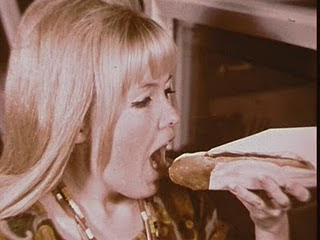
In 1969, when the educational film "LSD: A Case Study" was made, LSD was the hippie drug of choice, spurred on by the likes of Timothy Leary, Ken Casey, and acid rock concerts. Parents were disturbed, and hospitals were beginning to fill up with hippies thrown into LSD induced psychoses. Ronald Reagan and Ed Meese began to wage war on the drug and the word was sent to schools to warn kids of the dire consequences of LSD use.  The funny thing about this particular educational film is that it actually makes LSD look appealing. If I wasn't tempted to use the drug before, this film changes all that and makes it look rather interesting. It starts with a rather cool and happening party. If I were a kid in the 60's watching this film, I'd want to be at this party. After the party, she goes to get a hot dog. The film repeatedly flashes images of this chick about to wrap her lips around this wiener. No doubt, the phallic connotations would be felt by young schoolboys watching this film. Suddenly, her hot dog turns into a troll-like creature who starts screaming at her. While not exactly the religious experience Timothy Leary claimed LSD would provide, it still sounds pretty cool to have a hot dog turn into an angry troll. In the end, the hippie chick stomps on the hot dog while it screams in pain. Which then begs the question - is losing a perfectly good hot dog the worst thing that can happen to you if you use LSD? This is the worst they could come up with? - from Retrospace

What I find very strange is that this film was produced by the Lockheed Aircraft Corp


CASE STUDY : LSD
LOCKHEED AIRCRAFT CORP
4MIN
USA

Saturday, August 7, 2010

LSD: Insight or Insanity (1966)

LSD Insight or Insanity is a 1966 U.S. documentary. Sal Mineo narrates this look at teen culture from hair, clothes, music, slang, and…yes, drugs. Doctors in white lab coats explain an acid drug trip while the screen drips and swishes cool colors. But, be careful of the bad trip…it's a bummer! Psychedelic '60s. This is one of many films that were made very heavy handedly on the drug culture in america during the mid 1960's and early 1970's. These films were shown in classrooms across the country in attempt to scare kids from trying drugs.


LSD: INSIGHT OR INSANITY
MAX MILLER (1967)
18 MIN
USA

Sunday, August 1, 2010

The Terrible Truth (1951)

The Terrible Truth is a short educational film produced and directed by Sid Davis in 1951 it is the story of Phyllis who  falls for a slick drug pusher and gets hooked on “H.” After that, every day is a seriously bad hair day. She also stops tucking in her blouse. Eventually, Phyllis dries out and ends up back with her parents with a hideous new hairdo. Like all of Sid Davis' films they are made very heavy handedly. This film claims that just one puff off a joint will send someone down the road to insanity and death.


WATCH THIS FILM:

THE TERRIBLE TRUTH
SID DAVIS
10 MIN
USA
CLICK PLAY TO WATCH OR DOWNLOAD TO SAVE MPEG2 - 228MB

Wednesday, July 28, 2010

Reefer Madness (1936)

Reefer Madness (aka Tell Your Children) is a 1936 American exploitation film revolving around the tragic events that ensue when high school students are lured by pushers to try "marihuana": a hit and run accident, manslaughter, suicide, attempted rape, and descent into madness all ensue. The film was directed by Louis Gasnier and starred a cast composed of mostly unknown bit actors. It was originally financed by a church group and made under the title Tell Your Children. The film was intended to be shown to parents as a morality tale attempting to teach them about the dangers of cannabis use. However, soon after the film was shot, it was purchased by producer Dwain Esper, who re-cut the film for distribution on the exploitation film circuit. The film did not gain an audience until it was rediscovered in the 1970s and gained new life as a piece of unintentional comedy among cannabis smokers. Today, it is in the public domain in the United States and is considered a cult film. It inspired a musical satire, which premiered off-Broadway in 2001, and a Showtime film, Reefer Madness, based on the musical.

Mae Coleman (Thelma White) and Jack Perry (Carleton Young), her lover, sell weed. Mae prefers to sell weed to customers her own age, whereas Jack sells the plant to young teenagers. Ralph Wiley (Dave O'Brien), a psychotic ex-college student turned fellow dealer (and addict, according to the film), and Blanche (Lillian Miles) help Jack sell cannabis to young students. Young students Bill Harper (Kenneth Craig) and Jimmy Lane (Warren McCollum) are invited to Mae and Jack's apartment by Blanche and Ralph. Jimmy takes Bill to the party. There, Jack runs out of reefer. Jimmy, who has a car, drives him to pick up some more. Arriving at Jack's boss' "headquarters," he gets out and Jimmy asks him for a cigarette. Jack gives him a joint. Later, when Jack comes back down and gets into the car, Jimmy drives off dangerously, along the way running over a pedestrian with his car, although he survives. Jack agrees to keep Jimmy's name out of the case, providing he agrees to "forget he was ever in Mae's apartment"; for the moment, Jimmy does indeed escape the consequences of his crime - a rare occurrence in the film. Bill begins an affair with Blanche. Mary (Dorothy Short), Jimmy's sister and Bill's girlfriend, goes to Mae's apartment looking for Jimmy, and accepts a joint from Ralph, thinking it to be a normal cigarette. When she refuses Ralph's advances, he tries to rape her. Bill comes out of the bedroom after having sex with Blanche, and hallucinates that Mary strips for Ralph. He attacks Ralph, and as the two are fighting, Jack tries to break it up by hitting Bill with the butt of his gun. The gun goes off and Mary is killed. Jack puts the gun in the hand of an unconscious Bill, and wakes him up. Bill sees the gun in his hand, and is led to believe that he has killed Mary. The group of dealers lies low for a while in Blanche's apartment while Bill's trial takes place. Ralph, losing his sanity, wants to tell the police who is actually responsible for the death of Mary. The film attributes Ralph's insanity to marijuana use. Seeking advice from his boss, Jack is told to shoot Ralph so he keeps his mouth shut. Meanwhile, at the apartment, Blanche offers to play some piano music for Ralph to keep his mind off things. They are both very high, and Ralph tells her to play faster. She increases her playing speed to a downright cartoon-like speed in one of the film's most famous and over-the-top sequences. Jack shows up and Ralph immediately senses that Jack wants to kill him, so he kills Jack by beating him to death. The police arrest Ralph, Mae, and Blanche. Mae talks, and the criminal gang is rounded up. Blanche explains that Bill was innocent, and he is released. Blanche is then held as a material witness for the case against Ralph, but rather than testify against him, Blanche jumps out a window and falls to her death, Ralph is put in an asylum for the criminally insane "for the rest of his natural life." Mae's ultimate fate is unspecified. The film's story is told in bracketing sequences at a lecture given at a PTA meeting by high school principal, Dr. Alfred Carroll. At the end of the film, he tells the parents he has been talking to that events similar to those he has described are likely to happen again, and then points to random parents in the audience and warns that "the next tragedy may be that of your daughter's... or your son's... or yours, or yours..." before pointing straight at the camera and saying emphatically "...or YOURS!" as the words "TELL YOUR CHILDREN" appear on the screen. Tell Your Children was financed by a church group and intended to be shown to parents as a morality tale attempting to teach them about the dangers of cannabis use.[1][2] Soon after the film was shot, however, it was purchased by notorious exploitation filmmaker Dwain Esper, who took the liberty of cutting in salacious insert shots and applying the more scandalous title of Reefer Madness, before distributing it on the exploitation circuit.[1] Such education-exploitation films were common in the years following adoption of the stricter version of the Production Code in 1934. Other films included Esper's own Marihuana (1936) and Elmer Clifton's Assassin of Youth (1937), and the subject of cannabis was particularly popular in the hysteria surrounding Anslinger's 1937 Marihuana Tax Act. The film was reissued under a number of alternate titles, including The Burning Question, Dope Addict, Doped Youth and Love Madness. The concept of after-market films in film distribution had not yet been developed, especially for films that existed outside the confines of the studio system, and were therefore considered "forbidden fruit." For this reason, neither Esper nor the original filmmakers bothered to protect the film's copyright, and it eventually fell into the public domain. In 1971, Reefer Madness was discovered in the Library of Congress archives by NORML founder Keith Stroup, who bought a print for $297, and made it the darling of pot smokers and college campuses. For this modern audience, the poor production values and overacting create an uproarious comedy. Distributing Reefer Madness to college campuses of the 1970s helped bankroll the burgeoning film company New Line Cinema.


Today, Reefer Madness is considered to be a cult classic, and one of the best examples of a midnight movie. Its fans enjoy the film for the same unintentionally campy production values that made it a hit in the 1970s. Sean Abley's stage adaptation, Reefer Madness, ran for a year in Chicago in 1992. The film was spoofed in a musical of the same name, which was later made into a made-for-television film in 2005, which featured major actors such as Alan Cumming, Kristen Bell, Christian Campbell, and Ana Gasteyer.


WATCH THIS FILM:


REEFER MADNESS
LOUIS GASNIER   (1936)
MOTION PICTURE VENTURES
68 MIN
USA

Sunday, April 25, 2010

The Cocaine Fiends (1935)

If we’re going strictly by volume of output, Willis Kent’s main gig during the 1930’s and 1940’s was the production of a string of zero-budget westerns. However, because cheap and shoddy westerns were a dime a dozen in those days (in fact, I’ve had a few cross my path in regard to which that familiar turn of phrase may have been literally true…), it is not for those that the few of us who do so still remember him. For us, his big claim to fame is that, together with Dwain Esper and Kroger Babb, Kent was a leading figure from the earliest days of the underground exploitation movie. In particular, Kent was among the first on the scene with a drug-panic movie, having released his farm-boys-in-big-city-peril flick, The Pace that Kills, as early as 1928. Of course, even the roadshow circuit had little use for silent films by the mid-1930’s, and Kent eventually decided that a remake was in order. Thus it was that The Pace that Kills was reborn in new and more lurid form as The Cocaine Fiends. Just as before, what we have here is an excuse to wallow as deeply in vice and depravity as the censor would allow (which was actually a fair sight deeper than a literal reading of the Production Code should have permitted), thinly disguised as a cautionary message to concerned citizens everywhere. But this second time around, Kent ups the ante by putting the focus initially on a country girl who gets herself, her brother, and eventually just about everyone she meets into all sorts of trouble.

A gangster named Nick (Noel Madison) has been ordered by his boss in the city to expand the mob’s drug trade into the hick towns of the hinterland, and with that in mind, he and an associate are schlepping out into the country with a briefcase full of coke and enough gripes and grumbles to last them the whole trip. Before long, though, Nick notices that they’re being followed, and on the reasonable assumption that the men in the car trailing them are police officers, he has his driver drop him off at a roadside diner while the view between the two vehicles is temporarily blocked by a sharp bend in the road. While the police continue on in pursuit of the car, Nick takes the drugs inside and orders up a chicken dinner from counter girl Jane Bradford (Lois January, from Life Returns), addressing her understandable curiosity about the circumstances of his arrival with a cock-and-bull story about being a traveling businessman trying to escape from a gang of hijackers. Nick and Jane get to chatting while the food cooks, and she tells him about how she’s working at the diner in part to pay the cost of sending her brother, Eddie, to college. Nick, meanwhile, tries to convince her that she’s wasting her life out there in the sticks, and ought to move to the city, where he’s certain some friends of his in the entertainment business could get her a job. Eventually, however, those “hijackers” show up at the diner (having caught, searched, and interrogated Nick’s accomplice to no avail), and Nick is forced to hide in the kitchen until they go away. Jane proves not to be quite so naïve as she appears at first, because she quite rapidly figures out that Nick’s foes are really cops. Nevertheless, she doesn’t rat him out, and in fact seems more interested in him than ever after the police go away and Nick emerges from hiding to finish his meal. And it is during this second conversation that Jane begins her downfall, for she happens to complain of a headache, and Nick tells her he’s got the best medicine going right there in his briefcase.

Jane sees an awful lot of Nick over the ensuing days or weeks or however the hell long it’s supposed to be (you’ll certainly never figure it out from watching the movie), and a sort of openly exploitive, one-way romance— consistently lubricated by Nick’s wonderful “headache powder”— develops between them. Eventually, Nick gets ready to return to the city, and Jane agrees to go with him, with the understanding that the two of them will get married once they arrive. Yeah. Right. Jane ends up as nothing but the latest in a long line of disposable molls, and possibly a prostitute as well. After she’s spent a little while in the city, one of her colleagues clues her in to the nature of that white stuff she’s been sucking up her nose every couple of days since she fell in with Nick, and the collective shame of everything that has befallen her leads her to change her name to Lil. She never writes to her mother anymore, either.

But let’s put Jane/Lil/whatever on the back burner for a bit, and pick up the story of her brother (Dean Benton, from The Return of Chandu, whose later appearance in Willis Kent’s Confessions of a Vice Baron may have come courtesy of footage recycled from The Cocaine Fiends— that’s definitely how Noel Madison got in there, anyway). Eddie, as you may recall, was going to school when his sister met Nick, and a year later, he moves into town himself with the intention of discovering just what has become of her. He gets a job as a car hop at a burger joint, where he befriends his cute, perky coworker, Fanny (Sheila Manners— later known as Sheila Bromley— from Torture Ship and Barn of the Naked Dead). Alas for Eddie, Nick is one of the drive-in’s regular customers, and the gangster keeps Fanny well stocked with blow. She turns Eddie on to the stuff, and before we know it, our homespun hero is getting up to such scandalous shenanigans as going out on dates, having dinner at high-priced nightclubs (on Fanny’s dime— pretty girls always get tipped better, you know), and dancing to swing music. Is it me, or is this movie running through its Progression of Vice act backwards? Before we know it, Eddie has forgotten all about finding his missing sister, he and Fanny are living in sin in a flophouse, and she’s spending the night shift prostituting herself for coke money. Then one of her johns gets her knocked up, she and Eddie have a falling out over the other man’s fetus, and Fanny gasses herself to death in the apartment while her boyfriend runs off and trades up to heroin.


Meanwhile, there’s yet a third parallel plot, this one concerning Dorothy (probably The Black Room’s Lois Lindsay— the credits are unclear below a certain level of billing), the spoiled teenage daughter of a once gigantically wealthy businessman (Frank Shannon, who played Dr. Zarkoff in Flash Gordon and Flash Gordon’s Trip to Mars) who has been hit hard by the Depression. Dorothy’s thrill-seeking (which is rather less risibly tame than Eddie’s) leads her to a nightclub called the Dead Rat, which is owned by Nick’s mob. Nick notices the girl, and has her kidnapped. His idea is to reduce the big boss to the level of figurehead by keeping him busy with a demanding young girlfriend, so that he can seize power from behind the scenes; since the chief has always had a thing for feisty blondes, Nick reckons Dorothy for a sure bet. What he doesn’t realize is that the big boss is really Dorothy’s own father, who turned to crime to maintain his family’s lifestyle after the stock market went tits-up in October of 1929. The three plot threads do finally wind their way back together, but when they do, you’ll almost wish they hadn’t.
Well I don’t know about you, but now that I see how cocaine addiction leads directly to such vile and sinful behavior as listening to bebop and going to see really shitty vaudeville acts, I’m staying the hell away. No more “sleigh-rides with the snowbirds”* for me, thanks— from now on, I’ll be getting high on Jesus instead. Actually, the really strange thing about The Cocaine Fiends is the scattershot, mix-and-match portrayal it gives to its fallen characters’ lives of vice. Half the time, Kent and company act like there could be nothing in the world worse than neglecting to keep up correspondence with your mother out in the country, but then out of nowhere, they’ll take a sharp 180, and lay on a real downer of a subplot like Fanny’s descent from party girl to prostitute to abandoned, pregnant suicide. Eddie’s hilariously square “rebellion” ends with him passed out on a bunk in a Chinese-run opium den, and there’s little indication of how the one scenario leads into the other. Dorothy, on the other hand, pursues her own damnation sustainedly, systematically, and with much greater seriousness, yet she winds up happily married to an undercover cop! Meanwhile, the film’s treatment of the business side of dope-peddling is bizarre indeed, in that only once do we ever see anybody paying Nick for a hit. To all appearances, the pushers aren’t in it to make money, but rather expressly to lead the innocent into corruption. It’s this failure of the pieces to fit together into any kind of thematically consistent whole that exposes The Cocaine Fiends as a shameless exercise in salaciousness, instead of the plea for public action promised by its stern and hectoring opening crawl. You’ve got to wonder whether anyone in the audience ever bought the cover story, or whether everybody but the Hays Office and the Legion of Decency was in on the scam from the get-go.

WATCH THIS FILM:

THE COCAINE FIENDS
WILLIS KENT (1935)
68 MIN
USA


CLICK TO PLAY
DOWNLOAD TO SAVE
MPEG2 / 2.1GB

Saturday, April 24, 2010

The Mind Benders: LSD and the Hallucinogens (1970)

The Mind - Benders: Lysergic acid diethylamide (LSD) and the Hallucinogens, ca. 1970. ARC Identifier 13260 / Local Identifier 88.6. This film explores the history of hallucinogenic drugs, and specifically the effects and therapeutic uses of lysergic acid diethylamide (LSD). Combining graphics that suggest a hallucinogenic experience, snippets of interviews with users (who explain their reasons for taking the drug) and doctors, and taped sessions of research with volunteers, the film delves into the destructive as well as possible positive uses of the drug.


WATCH THIS FILM:

Sunday, April 18, 2010

Drug Addiction (1951)

This 50s Encyclopedia Britannica anti-drug film is about as campy as IÂve ever seen EB get. It tells the story of Marty, a nice, clean-cut 50s teen who succumbs to peer pressure and tries reefers. Before you know it, heÂs a junkie mainlining heroin, and then experiences the inevitable downward spiral of losing his part-time job at the grocery store, worrying his parents, getting snubbed by all the other clean-cut teens, turning to shoplifting and thievery to support his habit, and finally becoming a drug pusher. Eventually he gets arrested for all of this and, after his mother tearfully tells the judge that heÂs a Âgood boy, gets court-ordered into substance abuse treatment. But after he gets out of rehab, all the nice teens still shun him and he has to contend with pressure from his old junkie pals to start using again. This well-worn story is told in an incredibly dorky and hyperbolic fashionÂÂhighlights include MartyÂs friends getting sick when they first smoke marijuana (Marty also feels sick but hides itÂÂthe sign of a true addict-in-the-making), Marty and his friends drinking Pepsi from broken bottles while in a hopped-up state, MartyÂs mother trying to talk to her surly son about her worries about him, and the post-rehab Marty trying to resist the pressure of his old junkie pal, Duke, to start using again. For those who like to laugh at anti-drug films, this one is a classic.

WATCH THIS FILM:


DRUG ADDICTION
ENCYCLOPEDIA BRITANNICA (1951)
21 MIN
USA
DOWNLOAD / MPEG2 / 386MB

Saturday, April 17, 2010

Marijuana (1968)

Marijuana  is a short film that is hosted by Sonny Bono who does a lot of preaching and signify about how marijuana is illegal and you kids shouldn't try it. This is interesting considering Mr. Bono looks like he smoked a few bowls before appearing in front of the camera. This is a classic film that I remember seeing when I was in Jr.High school.
This film was one of many drug scare propaganda films that were shown in schools all over the country during the 1960's and 1970's. I have screened this film at many of my film programs over the years.

WATCH THIS FILM:

MARIJUANA
MAX MILLER (1968)
33 MIN
USA
DOWNLOAD/383MB